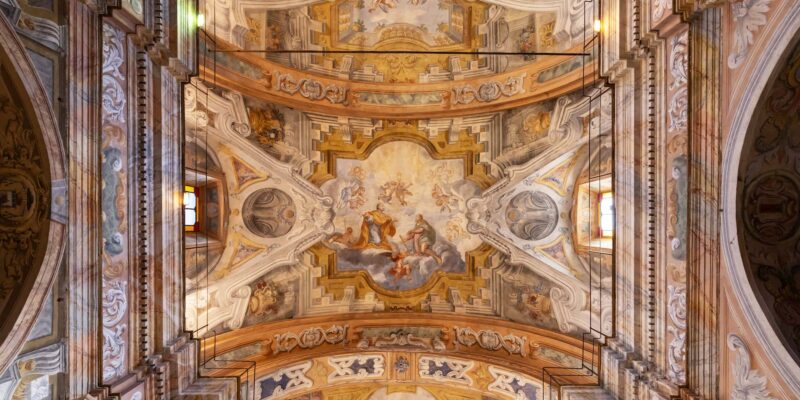
New Release: Hildebrand’s Mozart, Beethoven, Schubert, a celebration of the power and beauty of music, is now available in the first complete English edition.
The Dietrich von Hildebrand Scholarship at Franciscan University of Steubenville
Apply by April 16, 2025.
Up to two scholarships to MA Philosophy students at FUS will be awarded
For the 2025-26 academic year, the Hildebrand Project (HP) will fund up to two one-year scholarships for FUS MA philosophy students interested in working on Dietrich von Hildebrand. Applications for work on personalist thinkers (e.g., Wojtyla, Scheler, Stein) or Hildebrand’s immediate traditions (e.g., personalism, phenomenology) will be considered, though work on Hildebrand will be given preference. Up to $5,000 will be provided, if both scholarships are awarded. These scholarships, an expression of the fruitful relationship between the HP and FUS, will deepen and maintain the historical connection between FUS and personalist philosophy, while advancing new scholarship on Hildebrand and carrying forth the personalist tradition.
Scholarship Amounts in 2025-26:
- $2,000 for a first or second-year MA philosophy student
- $3,000 for a first or second-year MA philosophy student writing a MA thesis or one of two conference papers on Hildebrand (or related thinkers/traditions).
- Funds can be used at the scholarship recipient’s discretion for expenses related to their MA studies, including for tuition, living expenses, books, laptops, and so forth.
Application:
- Statement of purpose (1-3 pages) explaining the applicant’s interest in Hildebrand (or in related thinkers/traditions), how they will pursue this interest as a student in the FUS MA program, and how the work funded by the scholarship supports their longer-term aspirations, whether in academia, teaching, ministry, or any other field.
- Personal, intellectual, and professional (if relevant) biography (1-2 pages): How did you get here? Where are you going?
- Academic letter of recommendation explaining the applicant’s suitability for the scholarship. )
- One academic paper of any length.
- Resume or curriculum vitae.
- Recommendations must be submitted by the deadline. Letters of recommendation may be sent directly to events@hildebrandproject.org
- Submission deadline for the 2025-26 academic year: April 16, 2025
Review:
- Scholarships are awarded by the HP’s grants committee to admitted MA philosophy students.
- Priority will be given to applicants who have an expressed interest in pursuing an academic vocation.
- Award decisions will be communicated by May 1, 2025.
Opportunities During and After the Scholarship Period:
- Recipients will have the chance to work with senior Hildebrand scholars.
- Recipients will be invited to apply for the HP’s advanced programs, including weekend colloquia (travel stipend, room and board), advanced readings groups, and so forth.
- As part of the program, recipients will have access to the archives and potential paid work in the archiving and classification of said archives.
The Dietrich von Hildebrand Scholarship at Franciscan University of Steubenville
Apply by May 1, 2024.
Up to two MA Philosophy students at FUS in the 2024-25 Academic Year will be awarded
For the 2024-25 academic year, the Hildebrand Project (HP) will fund up to two one-year scholarships for FUS MA philosophy students interested in working on Dietrich von Hildebrand. Applications for work on personalist thinkers (e.g., Wojtyla, Scheler, Stein) or Hildebrand’s immediate traditions (e.g., personalism, phenomenology) will be considered, though work on Hildebrand will be given preference. Up to $5,000 will be provided, if both scholarships are awarded. These scholarships, an expression of the fruitful relationship between the HP and FUS, will deepen and maintain the historical connection between FUS and personalist philosophy, while advancing new scholarship on Hildebrand and carrying forth the personalist tradition.
Scholarship Amounts in 2024-25:
- $2,000 for a first or second-year MA philosophy student
- $3,000 for a first or second-year MA philosophy student writing a MA thesis or one of two conference papers on Hildebrand (or related thinkers/traditions).
- Funds can be used at the scholarship recipient’s discretion for expenses related to their MA studies, including for tuition, living expenses, books, laptops, and so forth.
Application:
- Statement of purpose (1-3 pages) explaining the applicant’s interest in Hildebrand (or in related thinkers/traditions), how they will pursue this interest as a student in the FUS MA program, and how the work funded by the scholarship supports their longer-term aspirations, whether in academia, teaching, ministry, or any other field.
- Personal, intellectual, and professional (if relevant) biography (1-3 pages): How did you get here? Where are you going?
- Academic letter of recommendation explaining the applicant’s suitability for the scholarship. Letters of recommendation should be sent directly to events@hildebrandproject.org
- One academic paper of any length.
- Resume or curriculum vitae.
- Submission deadline for the 2024-25 academic year: May 1, 2024
Review:
- Scholarships are awarded by the HP’s grants committee to admitted MA philosophy students.
- Priority will be given to applicants who have an expressed interest in pursuing an academic vocation.
- Award decisions will be communicated by May 15, 2024.
Opportunities During and After the Scholarship Period:
- Recipients will have the chance to work with senior Hildebrand scholars, including FUS Professor Emeritus John F. Crosby.
- Recipients are expected to participate in the HP’s annual summer seminar at FUS.
- Recipients will be invited to apply for the HP’s advanced programs, including weekend colloquia (travel stipend, room and board), advanced readings groups, and so forth.
- As part of the program, recipients will have access to the archives and potential paid work in the archiving and classification of said archives.
Personalist Essay Contest
Papers due July 1.

Deadline to Apply
July 1, 2023
Location
The 2023 ACPA conference will be held in Houston, TX.
The Hildebrand Project invites graduate students to submit an essay on any theme in the work of personalists Dietrich von Hildebrand, Max Scheler, or Edith Stein, to be presented at the 2023 ACPA annual meeting in Houston (November 16-19).
Submission Guidelines
- Essays should be prepared for blind review and e-mailed to Dr. Mark Spencer at spen8444@stthomas.edu.
- Essays should be approximately 20 minutes of reading time.
- Essays will be judged by a committee of senior personalist scholars.
- Essays must be submitted by July 1, 2023.
Three winners will be selected
- Winners will be awarded $600 to cover travel, lodging, and other expenses to attend the 2023 ACPA.
- Winners will present their papers at the Hildebrand Project’s 2023 ACPA satellite session and responses will be given by senior personalist scholars.
- For questions or more information, please email the Hildebrand Project at (info@hildebrandproject.org)or Dr. Mark Spencer (spen8444@stthomas.edu)
The flyer for this event can be downloaded here (PDF).
Dr. Robert E. Wood Tribute

By Christopher T. Haley
Student of Dr. Wood and Vice President of the Hildbrand Project.
The Hildebrand Project mourns the passing of Dr. Robert E. Wood (October 20, 1934 – February 10, 2023). Dr. Wood was a longtime friend and colleague of Hildebrand Project co-founder Dr. John F. Crosby and he was my teacher at the University of Dallas. Indeed, it was Dr. Wood who suggested I seek out the Hildebrand Project nearly a dozen years ago—little did I know (though I believe he knew) that he was setting me on my life’s course.
Dr. Wood was a Renaissance man, a scholar, an athlete, a sculptor, and a philosopher in the Platonic sense: a musical man of ordered harmony. He wrote on all the great philosophers, but he had a special love for Plato. I still recall coming into his office one day to find him reading Plato’s Meno, a text he must have read dozens of times and certainly didn’t need to re-read. He wasn’t teaching the book anytime soon or writing on it; he was just enjoying it. Dr. Wood always said: “There is no reading; only re-reading.” Despite his prolific output and many accolades (you may read his obituary here), he was always a student; and to be his student was to be a student with him, to join him on a journey through great ideas and the untold beauty of the world. He was a Virgil to his students.
We called him “the maestro” on account of the way he would conduct his classes. He held whole philosophical systems in his repertoire, and could bring them to vision before your eyes and mind. Whatever he taught, he wanted to convey its beauty. He was like St. Thomas in always giving every position its most charitable and compelling account. That intellectual charity is one of the most important lessons I learned from him. Try as I might to dismiss a thinker (usually Hume), he would urge me to understand why we read this and to find what is best and important (even in Hume!).
He showed this same charity to his students too, finding what was best in their work and in them as persons. I once wrote a paper on Kant; I received it back with a “B” and a comment that it was a good paper on Plato! He was as interested in my love for poetry and my family as he was in my pursuit of philosophical studies. At the heart of Dr. Wood’s interest was the core of the person, the “inner heart,” as he used to say. The influence of Dietrich von Hildebrand is evident; and, while I never studied Hildebrand with Dr. Wood, he would often refer to The Heart and Liturgy and Personality as being two of the most important books in his philosophical formation.
It was thus a personal and professional joy for me to invite him to author an introduction to Hildebrand’s Aesthetics, and to host him as a speaker for our 2017 summer seminar on Retrieving Beauty (the videos are available here). His last publication, just a month before he died, was Being Human: Philosophical Anthropology through Phenomenology and he was still at work on his last book, fittingly, a book on the heart.
A friend, a mentor, a student, and a scholar; a family man, a faithful man, and a gentleman; we have lost a truly great person and a refulgent personality in Dr. Wood. His legacy lives on in his beautiful family, his myriad students, his enduring impact on Catholic philosophy, the University of Dallas community, and, in some small way, in the Hildebrand Project.
Dr. Wood thought we should all sing more, particularly at the end of events and gatherings. I thus invite you to join us in your hearts in singing:
Salve, Regina, Mater misericordiæ,
vita, dulcedo, et spes nostra, salve.
Ad te clamamus exsules filii Hevæ,
Ad te suspiramus, gementes et flentes
in hac lacrimarum valle.
Eia, ergo, advocata nostra, illos tuos
misericordes oculos ad nos converte;
Et Jesum, benedictum fructum ventris tui,
nobis post hoc exsilium ostende.
O clemens, O pia, O dulcis Virgo Maria.
Ora pro nobis, sancta Dei Genitrix,
Ut digni efficiamur promissionibus Christi.
Benedict XVI & The Hildebrand Project
We Remember Pope Benedict XVI
The death of Pope Emeritus Benedict XVI has unleashed a flood of assessments of his legacy as pontiff. It will be years, and probably decades, before the full scope of his magisterium will be grasped, in large measure because his immense body of teaching and preaching is still being absorbed.
While I don’t have a privileged perspective on Benedict’s papacy as a whole, I was privileged to receive his extraordinary support in founding the Hildebrand Project. Without Benedict’s early and repeated support, it is possible the Hildebrand Project would not have attracted the intellectual and financial support that has enabled it to thrive.
Popes are usually judged by their major achievements (and failures); consequently, many commentators are likely to consider papal support of small initiatives fairly immaterial. I think this is mistaken, not only because these initiatives often have significant ramifications of their own, but also because they provide small glimpses into the priorities of a papacy.
The Early Years of the Hildebrand Project
The Hildebrand Project was founded in February 2004. At the time, its primary goal lay in the English translation and publication of the German writings of Dietrich von Hildebrand. I was the young founder, age 25. I had studied philosophy and pursued a career in violin performance; my background prepared me to love the good, the true, and especially the beautiful, but there was little in it to prepare me to undertake institution-building and fundraising. It was a blessed ignorance, nourished by my youthful confidence that almost everything is possible with vision, passion, and hard work.
At the time, Alice (Lily) von Hildebrand was extremely encouraging to me, yet (as I later learned) not completely confident that this young man knew what he was getting himself into and whether he could succeed. Still, she generously supported my bold (or were they brash?) plans. I had enough sense to realize that I needed a group of distinguished persons to lend credence to the nascent Project, so I created our Advisory Council with the idea that I would invite known persons who exemplified different aspects of Hildebrand’s legacy: groundbreaking philosopher, penetrating religious author, ardent lover of beauty, and heroic political witness.
Among the very first we invited was a certain Joseph Cardinal Ratzinger. Lily sent the letter in her name. The response was swift. “I would be honored to serve, but given my role in the Church, I cannot join the Advisory Council, but something honorary I would not exclude.” Thus was born the title, Honorary Member. I have a lovely brief letter dated October 2004, saying:

I used to say that with Cardinal Ratzinger’s “Yes,” the Hildebrand Project was born. Perhaps I should say that his “Yes” confirmed in me the sense that this work was not just an interesting scholarly venture, but a mission that could serve the Church and the world in crucial ways. Since that time, I have never looked back.
The Holy Father’s Contribution to the Project
On April 19, 2005, Cardinal Ratzinger was elected pope. I will never forget the moment when he first appeared on the balcony to be presented to the world as Benedict XVI. I was overcome with joy! I was also certain this marked the end of his involvement with the Hildebrand Project. I was grateful, but ever so slightly disappointed. After all, we were just getting underway.
In the fall of 2005, I had the chance to submit a proposal to the Papal Foundation, an American foundation that provides support to crucial papal charitable priorities. It was a long shot, but I was hopeful. Imagine my surprise and delight when we received a sizable grant that became some of the most crucial early-stage funding we received. I assumed the Holy Father gave his blessing to all the grants made by the Papal Foundation, but I did not think he played an active role in the review process.
In June 2006, I had the chance to greet the Holy Father at one of his Wednesday audiences in Rome. The heat was oppressive and the pope looked tired as he worked his way down the line of well-wishers, many of whom handed him gifts. I had been rehearsing what I would say in my 30 seconds, and I had decided to speak in German. I said, “Holy Father, thank you for your generosity through the Papal Foundation. Your support is deeply appreciated.” Without a moment’s hesitation, he replied, “I put that grant through myself.” I was speechless. I could only stammer “Alice von Hildebrand sends her warmest greetings,” to which he asked about her health. His parting words were, “Sie ist eine edle Frau—she is a noble lady.”

Such words would humble anyone, and certainly Lily was deeply touched. But it also fired in us both a certain boldness: would the Holy Father perhaps receive us in a private audience? Again, she wrote a letter to the Holy Father, and within a few weeks, we had a reply: please come and here are three possible dates.
Our Audience with Pope Benedict XVI
After many adventures, which included a memorable visit to San Francesco, Dietrich von Hildebrand’s childhood home in Florence, Lily and I arrived in Rome in March 2007 in the company of our dear friend, Patricia Lynch. A close friend of Lily’s and a faithful Hildebrand Project trustee, Pat had graciously agreed to serve as travel companion to Lily, who was then 84.
Our audience with Pope Benedict was set for Monday, March 26, on which the Feast of the Annunciation was observed that year. Two groups were ahead of us, ultimately causing us to wait for at least an hour. Lily and Pat, more pious than me, began reciting a rosary while I prayed in decades of silent pacing. I kept telling myself that the Holy Father had an “obligation to be charitable.”
All at once, it was our turn. I think Monsignor Georg Gänswein, personal secretary to the Holy Father, greeted us just before we went in, but perhaps it was Archbishop James Harvey, the Prefect of the Papal Household. The door swung open and there stood the Holy Father to welcome us. Lily bent to kiss his ring, as did Pat and I. From the very first moment, there was a warmth and a spirit of friendship between Lily and the Holy Father as can only exude between Christian friends. There was something so dear and childlike when Lily, still in the doorway, said, “Your Holiness, I am older than you,” to which he said with a smile on his face, “Yes, I know.” After a group photo, the room was cleared, leaving just Lily and me with the Holy Father.

Though the audience remains firmly etched in my mind, with certain aspects still clear as yesterday, somehow the overall memory remains with me as if it were a dream. We began the conversation in German, then shifted to English, a mercy for me, since I knew I could speak more expressively in English than in German. The very first thing I did was to give the Holy Father copies of the Dietrich von Hildebrand LifeGuide and of The Heart, both of which had just been published. Taking The Heart, the Holy Father remarked, “Ah, the young people will like this.” This was also my opportunity to thank the Holy Father for his financial support through the Papal Foundation, which had been so critical for our early success.
Lily too spoke about various themes. In fact, she arrived with a full agenda! At one point, she asked the Holy Father to write a new encyclical on Christian philosophy with a special focus on encouraging the study of philosophers, such as her husband, who were not primarily disciples of St. Thomas Aquinas. The Holy Father’s response was very interesting, considering that his intellectual roots are in St. Augustine and St. Bonaventure. Referring to the encyclical Aeterni Patris (1879), in which Pope Leo XIII strongly encouraged the study of St. Thomas, Benedict remarked, “the encyclical was absolutely necessary at the time.” Various other topics came up, some of them highly sensitive in nature (e.g., the appointment of bishops). I remember being surprised at how candid the Holy Father was in his remarks.
Aside from thanking the Holy Father and presenting him with our first publications, I wanted to discuss various matters concerning the future of the Hildebrand Project. I had a particular request for him, which I asked for along the following lines. I said: “Dear Holy Father, we have been blessed by numerous friends and supporters, many of whom have been impressed to know of your involvement in our work. Yet, I think there would be even greater interest, allowing our work to flourish even more, if they were to feel a concrete collaboration with you. Would you be willing to write for me a personal letter, expressing not only your support of our work but also explaining in just a few lines, the reason for your support?” And without any hesitation, he replied, “I would be happy to. Send me a letter.”
Well, send him a letter I did, and, one can only imagine my surprise when just a month later a courier from the Papal Nunciature in Washington, DC arrived at my home in Alexandria, Virginia. I knew immediately what it must contain, though I could hardly believe it. My hands were shaking and I was so beside myself with excitement that I had to ask a friend to open the packet and read it to me. What I received in every respect exceeded what I had hoped for, and so it is with joy and an ongoing sense of indebtedness to the Holy Father that I share his letter with you here.

Nunc Dimittis
But let me return to the audience with Pope Benedict. It was now time for us to go. As we were getting up, Lily dropped one of her gloves onto the floor. Quick as a flash, Pope Benedict stooped to pick it up. He did it so naturally that it clearly did not cross his mind to do otherwise. We began walking toward the door, Lily holding the hand of the Holy Father. “You have no idea what a joy it is to see you,” she said. And twice, “Now I can truly say my Nunc dimittis,” referring to the words of Simeon in the Temple, “Now dismiss your servant according to your word in peace, for my eyes have seen your salvation.”
It must have been after noon. Various members of the Holy Father’s staff appeared in the room. I remember Archbishop Harvey standing behind the Holy Father, and I am certain that Monsignor Gänswein had also entered. Others were present as well. Then came the most memorable moment of all. We stood there, Lily still holding the hand of the Holy Father, with members of the papal household looking on. She could not let go. She was overjoyed. “If I could sing all of Mozart, Beethoven, and Schubert, it would not suffice to express my joy,” she said. There was peace and serenity in the room, and joy and expectancy.

I realized then that she saw with the eyes of faith, and in this, her vision was transformed. The man she saw was not just the former Joseph Ratzinger, whom she had known over many years; rather, she saw the one whom, in faith, she understood to be Christ’s representative on earth. It was a revelatory moment, a moment of grace, and I think that everyone in the room saw the Holy Father as she did. I certainly did.
Rest in peace, dear Holy Father.

John Henry Crosby
Founder & President